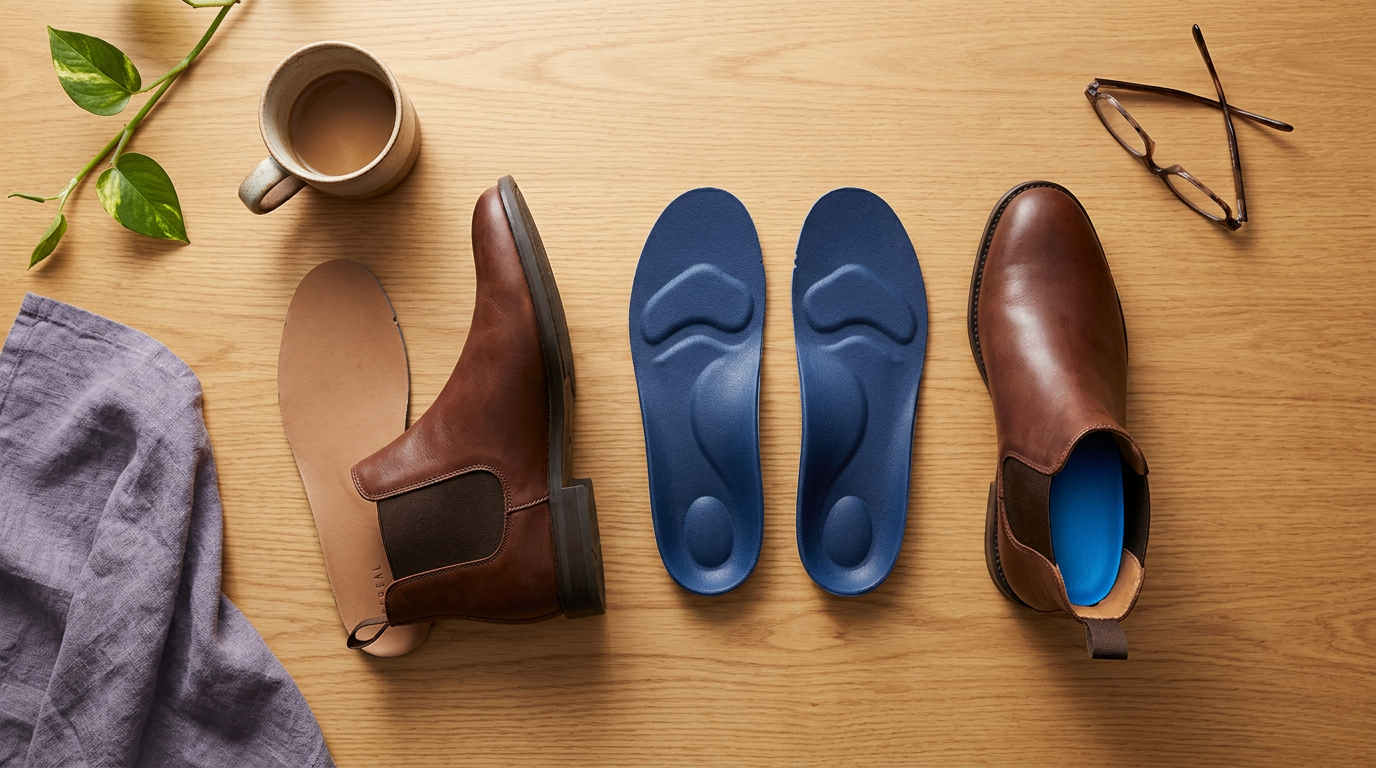
The insole that works for running does not work for standing. Running loads and unloads the arch in a cycle. Standing loads the arch continuously. That difference is why most insoles fail at a standing desk within weeks — they are designed for impact, not for sustained pressure.
This is the standing-desk-specific version of the broader Best Insoles for Standing All Day topic. The focus here is narrower: static standing, hardwood floors, and the weird way desk work stresses feet differently from walking.
If your feet hurt after two hours at a standing desk, the insole is almost always the cheapest and highest-impact fix. Cheaper than a new mat, faster than new shoes, and it travels with you to any surface.
What to look for#
Three features separate a standing desk insole from a walking or running insole:
1. Arch support that holds shape under static weight. The arch needs to be firm enough to maintain its profile when you stand still for 20 minutes. Soft foam and gel arches collapse under sustained load. A structured EVA or TPU arch is what you want.
2. A deep heel cup. Standing shifts your center of gravity rearward. A shallow heel cup lets the heel spread and sink, concentrating pressure on the rim. A deep cup (8mm+) cradles the heel, distributes load across the fat pad, and reduces the hot-spot pain that shows up after hour two.
3. Forefoot cushioning that does not bottom out. The ball of the foot takes constant pressure during standing. The forefoot pad needs enough density to absorb micro-movements without compressing flat. Dual-density foam (firm base, softer top layer) holds up better than single-layer gel.
Why gel insoles fail#
Gel feels great on day one. The problem is structural: gel deforms under sustained load and does not fully recover. Within two to four weeks of daily standing use, most gel insoles have compressed to the point where the arch support is cosmetic and the heel cup is flat. You end up standing on a thin, warm pad that is not meaningfully better than the factory insole it replaced.
Gel works for walking because the load-unload cycle lets the material recover. Standing removes the recovery window.
The picks#
As an Amazon Associate I earn from qualifying purchases.

Dr. Scholl's Work All-Day Superior Comfort Insoles
Mass-market gel work insoles for hard floors and long shifts. Easy budget pick, but softer and less structured than heavy-duty orthotic-style options.
- Best for: easiest low-cost upgrade when stock insoles are the main problem
- Why it works: soft cushioning and lower fatigue fast
- Tradeoff: lighter on true arch control

WalkHero Heavy Duty High Arch Support Insoles
Firm 220lb+ high-arch orthotic insoles for standing all day in work shoes and boots. Strong support lane for heavier bodies and flatter factory footbeds.
- Best for: firmer support in boots and harder standing-desk setups
- Why it works: stronger arch structure for longer static standing
- Tradeoff: less ideal if your shoes run wide

Fit Geno Heavy Duty Arch Support Insoles
Newer high-rated 220lb+ orthotic insole with aggressive arch support and Poron-style cushioning. Strong candidate for work boots and long hard-floor sessions.
- Best for: softer-feeling support when plantar-fasciitis-style pain is part of the story
- Why it works: real arch relief without feeling overly harsh
- Tradeoff: occasional squeak complaints
If you want the broader field, including more support-first options, use Best Insoles for Standing All Day.
Insoles plus mat: why you usually need both#
The insole handles what is happening inside the shoe — arch support, heel alignment, forefoot cushioning. The mat handles what is happening under the shoe — surface hardness, micro-movement encouragement, and lower-leg fatigue.
Neither replaces the other. On hardwood or concrete, an insole alone still leaves you standing on a surface that reflects all impact back through the sole. A mat alone still leaves your arch unsupported inside whatever shoe you are wearing.
For the full comparison, see Anti-Fatigue Mat vs Insoles: Which Do You Need?.