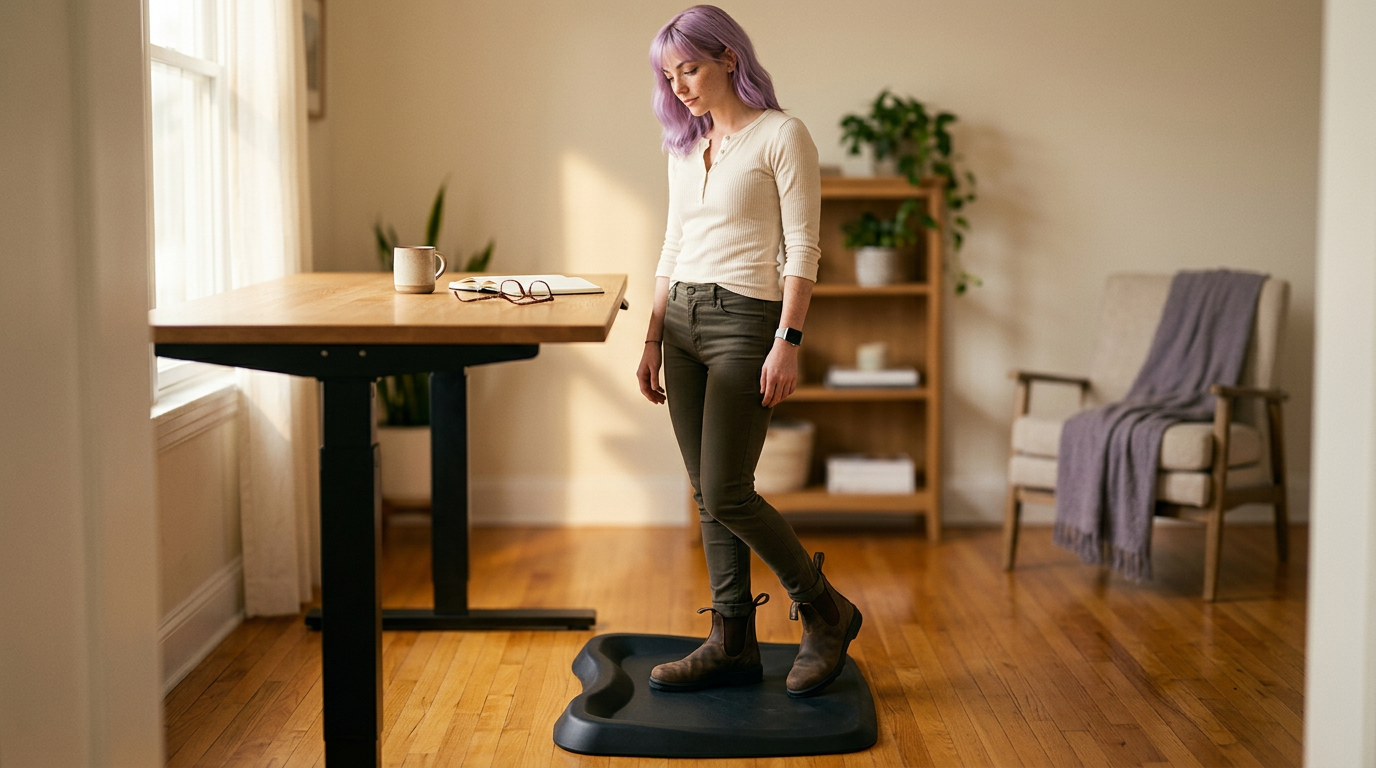
Blundstones have a head start over most boots at a standing desk. The Chelsea shape is lighter than a lace-up, the sole has more natural flex than a Dr. Martens air-cushion, and the elastic side panels mean fewer pressure points during the first few weeks. That is the good news.
The bad news: the stock footbed is still thin, flat, and built for walking — not for standing in one place for three hours. After two hours of static standing, the same arch fatigue, heel loading, and lower-back tension show up. The boot is better; it is not a solution on its own.
If you already read Dr. Martens at a Standing Desk, the diagnosis is the same. The fix stack is the same too — just easier to execute because Blundstones accept insoles more cleanly.
Why Blundstones fade after hour two#
The 500-series and 550-series both use a removable comfort insole that is about 3mm of foam over a flat base. For walking, it works. For standing, it compresses under body weight within the first hour and stops doing anything useful by hour two.
Three things still work against you:
- Minimal arch support: the factory insole fills space but does not hold the arch under static load.
- Thin midsole: the polyurethane outsole absorbs impact well on walks but does not cushion standing-specific pressure points.
- Heel loading: without arch engagement, your weight settles into the heel cup and forefoot — the two spots that hurt first.
The advantage over Docs: the toe box is wider, the leather is softer from day one, and the boot weighs less. All three make the insole swap more effective because there is less fighting the boot itself.
The fix#
Swap the insole#
Remove the factory insole (it pulls out cleanly in most Blundstone models) and replace it with a medium-arch work orthotic.
As an Amazon Associate I earn from qualifying purchases.
CRUVHEAL Work Orthotic Insoles Amazon ↗(read review) fit the Blundstone toe box well and hold their shape under all-day standing. The deep heel cup matters more in a Chelsea boot because the elastic panels allow slight heel movement — the cup locks your foot in place and stops the slide that causes hot spots.
Add the mat#
If you are on hardwood or concrete, an anti-fatigue mat under the desk completes the stack. The insole handles what is happening inside the boot; the mat handles what is happening under it.
See Anti-Fatigue Mat vs Insoles for the full comparison.
Keep the 20-8-2 rhythm#
Stand 20 minutes, sit 8, move 2. No boot — however well-insulated — replaces actual movement. The rotation is what keeps a standing desk sustainable past the first month.
When to retire the Blundstones from desk duty#
If you stand more than five hours daily and still feel fatigue with the insole and mat, the boot is the remaining bottleneck. Switch to dedicated comfort footwear at the desk — trainers, cork-bed sandals, or standing-specific shoes — and save the Blundstones for when you leave the house.
For the full roundup of standing desk footwear options, the standing desk shoes guide is still queued for publication.