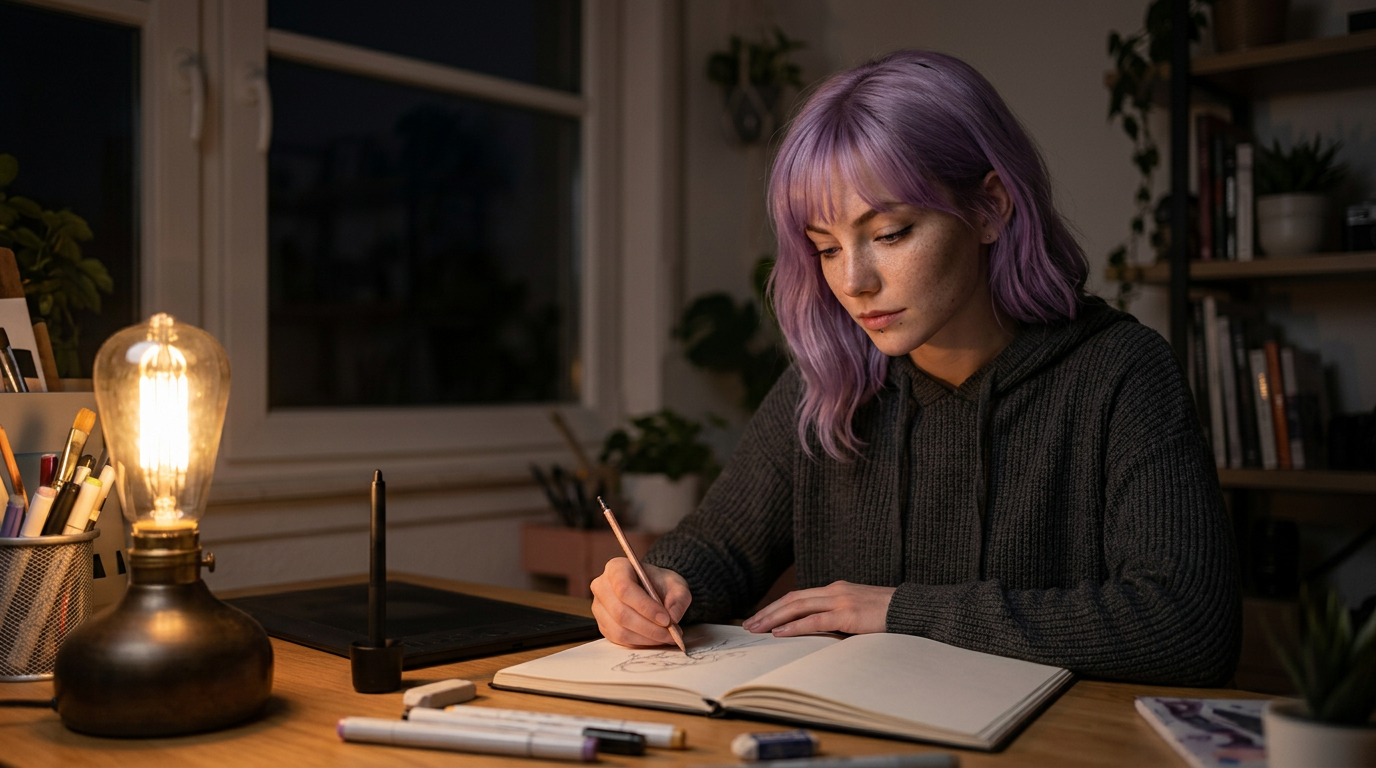
Late-night creative sessions are good for the work. They are hard on the sleep. The fix is not willpower — it is a setup that transitions as deliberately as it creates.
This guide covers the gear that earns its place between the desk and the bed: noise machines that remove your phone from the nightstand equation, lamps warm enough to not reset your circadian clock, and a power separation approach that lets the studio side go dark without affecting the sleep side.
Why creator setups fight sleep#
A creator rig is optimized for alertness. Bright, color-accurate key lights. High-refresh monitors close to your face. Notification channels staying open for collabs, uploads, and comments. The same conditions that produce good work are the conditions that delay sleep onset by 60 to 90 minutes when you stop.
The solution is physical separation — a room that can visibly change modes. Work gear off. Sleep gear on. Different zones, different light temperature, different audio environment. The transition does not happen in the head; it happens when the tools change.
The sleep-side gear stack#
White or brown noise machine#
The most important move is removing your phone from the nightstand audio role. A dedicated noise machine is quieter, has no notifications, and produces continuous sound that a phone battery-saving mode can interrupt.
Three options depending on what you want:
Best seller, lowest barrier: Magicteam White Noise Sound Machine Amazon ↗(read review)
20 non-looping sounds, USB or AC power, 32 volume levels with memory. The default recommendation — 67,000 reviews, sub-$20, ships fast. Starts working the same night.
Mechanical fan, zero digital artifacts: Yogasleep Dohm UNO White Noise Machine Amazon ↗(read review)
Real fan inside. Non-looping by physics. One speed, adjustable tone via the housing cap. No app, no digital samples, no loop point for a light sleeper to notice. The correct choice if you have tried digital machines and still wake up.
Sound plus night light in one device: Yogasleep Duet White Noise Machine & Night Light Amazon ↗(read review)
30 sounds, Bluetooth speaker, and a warm amber night light built in. Covers the noise machine and bedside lamp in one USB cord. The practical choice if the goal is fewer devices, not more.
Dim bedside lamp#
The key light off is the obvious move. The problem is what replaces it. Ceiling lights are too harsh. Phone screens are worse. A dedicated warm bedside lamp at genuine low brightness is the missing piece.
Warm output, practical utility: Fenmzee Dimmable Bedside Lamp Amazon ↗(read review)
Wood base, fabric shade, touch-dim in three levels. USB-C and USB-A charging ports plus AC outlet built into the base — charging works even when the lamp is off. Warm output, no app, replaces the power strip and the lamp in one device.
Simple touch with RGB option: ROOTRO Touch Bedside Lamp Amazon ↗(read review)
Hold the top sensor when the lamp is off for direct ultra-dim output — no cycling. RGB color mode for accent use if you want it. Colors are fixed brightness, not dimmable, so the warm white mode is where the sleep utility lives.
Late-session desk light#
The abrupt jump from a bright, color-accurate screen to a dark room is part of what keeps the brain in work mode. BenQ ScreenBar Halo 2 Amazon ↗(read review) softens both ends of the session: it bounces light off the wall behind the monitor, lowering the contrast between screen and room during the session, and it makes the eventual shutdown less jarring. Run it at its warmest color temperature after sunset.
Soft studio accent (desk side)#
Aputure Amaran MC Amazon ↗(read review) is the compact RGBWW accent that covers the desk-side transition. Run it warm-only for a soft ambient pool that does not blast your eyes after the key light goes off. Battery powered, magnetic mount, small enough to stay on a shelf permanently. The key light off plus this on is a visible mode switch the room can feel.
The power separation approach#
Route the sleep-side gear — lamp, noise machine — independently from the desk gear. The goal is one action that takes the monitors, key lights, and chargers to zero without requiring individual power-downs for every device.
A desk-mounted power strip with individual switches makes the desk side a single toggle. The sleep side stays on its own outlet or USB hub, untouched by the shutdown. When the desk goes dark, the nightstand stays lit and quiet.
If you share the space: keep the session quiet#
The other half of the problem is working late without waking a partner or roommate. Two changes handle most of it. Silent linear keyboard switches (Gateron Silent Red/Yellow or equivalent) cut keystroke noise to near-nothing while still feeling like a real keyboard — through a closed door they simply do not register. Closed-back headphones contain your monitoring at working volume, where open-backs leak by design.
A noise machine placed near the sleeper’s door does double duty here: it masks the low-level seepage you still generate — desk creaks, cable snaps, chair movement. The one activity no gear fixes is recording with a live mic. Schedule that around their sleep, and everything else — editing, grading, writing, mixing — is unconstrained at any hour.
The one-hour wind-down protocol#
| Time | Action |
|---|---|
| T-60 min | Set an alarm labeled “Screens off in 60.” Key light off, desk accent on. |
| T-45 min | Monitors off or set to night mode. Stop new task creation. |
| T-15 min | Desk power strip off. Noise machine and lamp on the nightstand on. |
| T-0 | Phone face-down, notifications silenced. Audio from noise machine, not phone. |
The protocol works because it is physical, not mental. Each step changes something in the room. By T-0, the room looks different from the work session, which gives the brain permission to switch modes.
Wrap-up#
The best creator sleep setup is the one that makes the transition visible and automatic. Gear that turns off cleanly, light that goes warm, sound that runs without your phone — that is the stack. It works the same whether the late session is editing, drawing, writing, or a podcast mix — the medium changes, the wind-down does not.