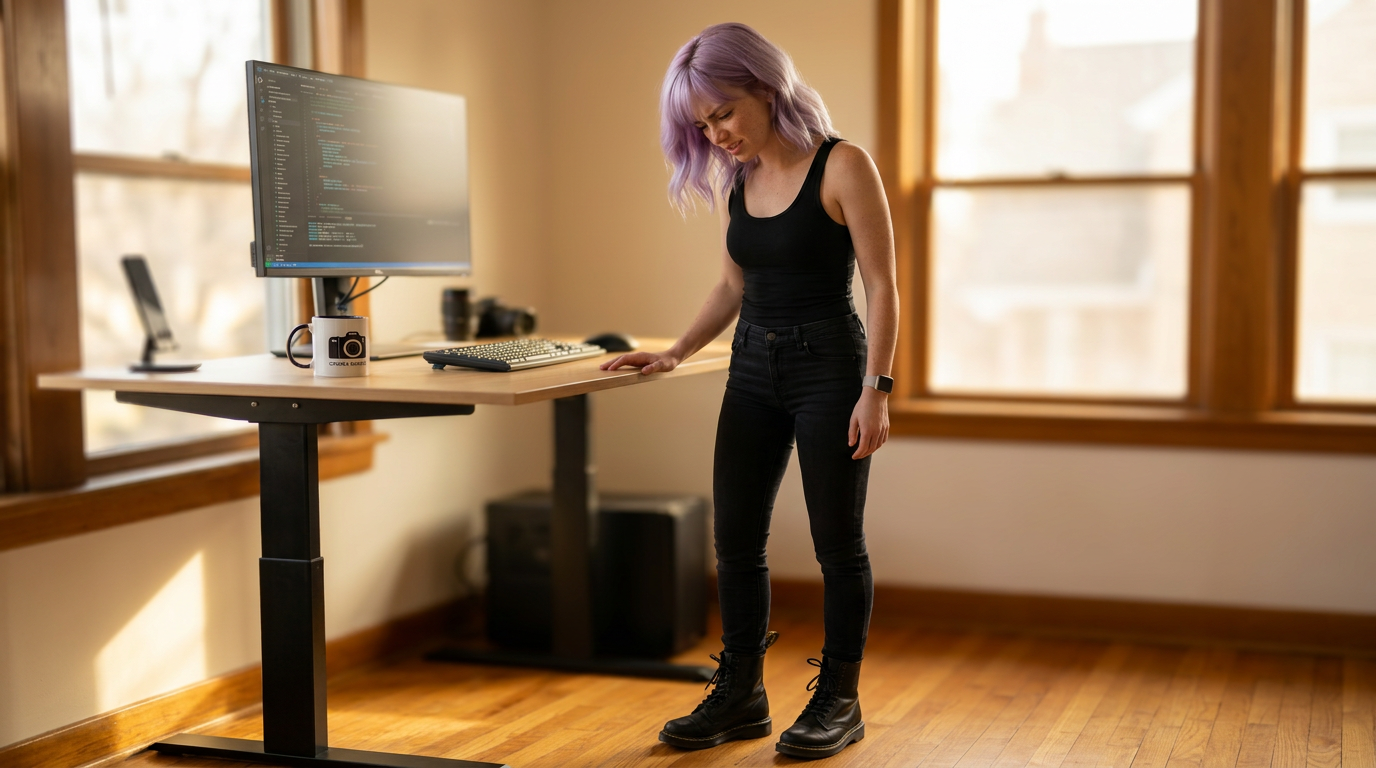
Dr. Martens are a style commitment, not a comfort product. If you just switched to a standing desk and your Docs hurt after an hour, the boots are not broken — they were never designed for this.
The flat footbed, heel-heavy weight distribution, and stiff leather sole are the exact opposite of what your feet want during a four-hour standing session. Pretending otherwise is the sponsored-content energy this site exists to counter.
The good news: two cheap interventions fix most of the pain. The better news: the fix stack works for almost any stiff-soled boot at a standing desk — Blundstones, Red Wings, Timberlands, all of them.
Why Docs hurt at a standing desk#
The 1460 and 1461 both ship with a flat, minimal footbed. That is fine for walking — the impact cycle loads and unloads the arch naturally. Standing is different. Static loading on a flat surface concentrates pressure on the heel and ball of the foot, and without arch support the plantar fascia absorbs the strain. Two hours in, your heels ache. Four hours in, your lower back joins the conversation.
Three things compound the problem:
- No arch support: the factory insole is cosmetic, not structural.
- Stiff sole: the air-cushioned sole is durable but does not flex with foot movement, so micro-adjustments that relieve pressure in softer shoes do not happen.
- Break-in weight: new Docs are heavy and rigid. Even broken-in pairs distribute weight differently from a running shoe or ergonomic flat.
If you are flat-footed, the effect is worse. The arch never engages, so the heel and forefoot take everything.
The fix stack (cheapest first)#
1. Replace the insole#
This is the single highest-impact change. Remove the factory insole and replace it with a medium-arch work orthotic. You want three things: arch support that holds its shape under body weight, a deep heel cup that centers your weight, and a shock-absorbing forefoot pad.
As an Amazon Associate I earn from qualifying purchases.
CRUVHEAL Work Orthotic Insoles Amazon ↗(read review) are built for exactly this use case — standing shifts on hard surfaces. Multiple buyers report using them specifically in work boots on concrete floors for 8–12 hour shifts, with callouts for plantar fasciitis relief and reduced leg fatigue. Fair warning: they feel firm at first and take 2–3 hours of wear to break in. That firmness is the point — soft gel insoles compress too fast under static standing and stop working within weeks.
2. Add an anti-fatigue mat#
If your standing desk sits on hardwood or concrete, the insole alone is not enough. An anti-fatigue mat with varied terrain encourages micro-movements that keep blood flowing and shift pressure points throughout the session.
Ergodriven Topo Standing Desk Mat Amazon ↗(read review) is the mat built for this — the contoured terrain keeps your feet shifting instead of locking into one position. The combination of a structured insole inside the boot plus a contoured mat under the boot is what makes multi-hour standing sustainable — neither works as well alone.
For the full breakdown on when you need a mat, insoles, or both, see Anti-Fatigue Mat vs Insoles.
3. Follow the 20-8-2 rule#
No footwear fix replaces movement. Stand for 20 minutes, sit for 8, move for 2. The cycle keeps circulation flowing and prevents the static-load fatigue that builds regardless of what is on your feet. If your standing desk does not have a sit option, even shifting weight side-to-side or stepping onto and off the mat counts.
When to switch footwear entirely#
If you stand more than four hours a day and the insole-plus-mat stack still leaves you sore, Docs may not be the right shoe for your standing setup. The stiff sole and heavy frame work against you at longer durations.
Footwear built for all-day standing — cushioned trainers, Birkenstock-style cork footbeds, or dedicated standing-desk shoes — will outperform any boot modification past the four-hour mark. Keep the Docs for the commute and the camera; switch to comfort footwear at the desk.
The bigger picture#
Your footwear is part of your standing desk loadout. If you have optimized desk height, monitor position, and keyboard placement but are wearing two-pound boots with zero arch support, you are solving the wrong variable.
The fix is usually cheap: an insole and a mat you may already own. Start there before blaming the desk or the boots.