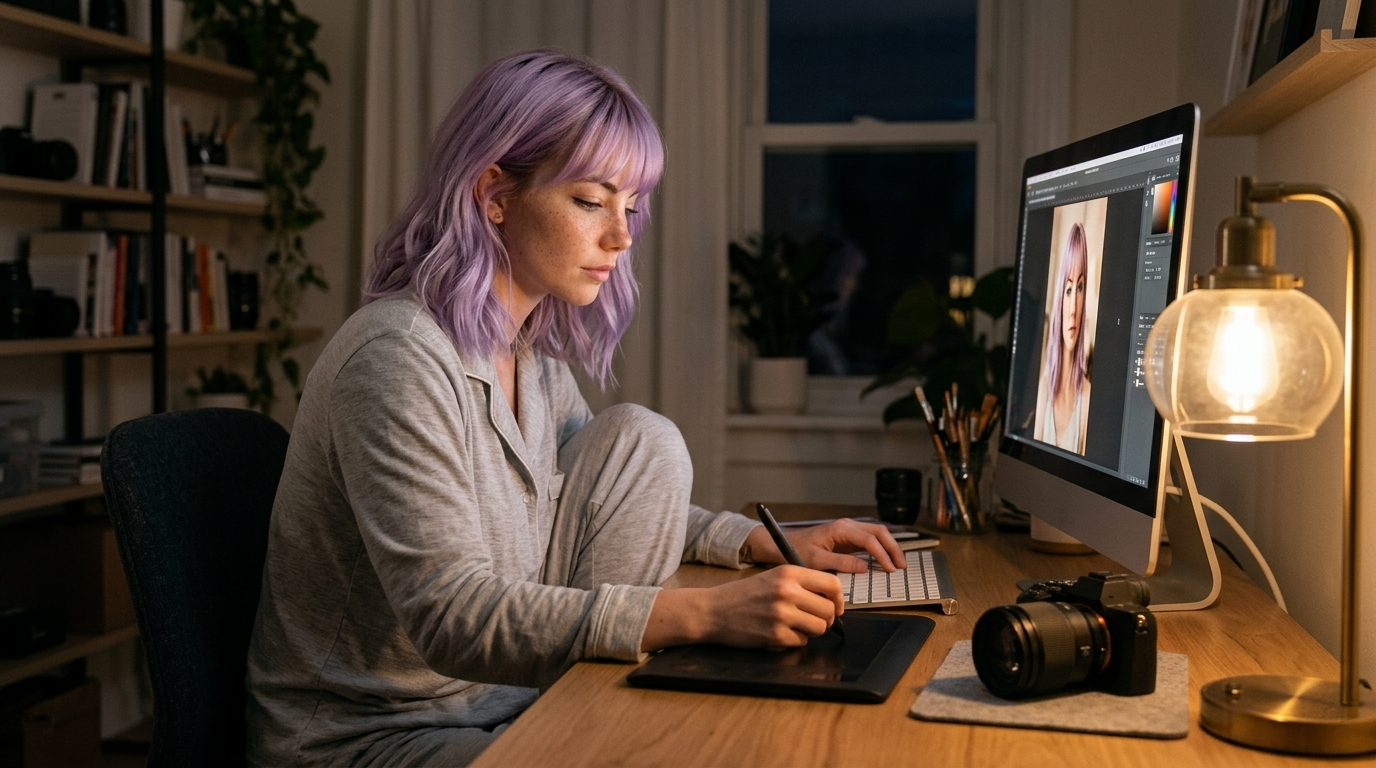
Photographers do not stop when the shoot ends. Culling a full-day shoot takes hours. A Lightroom session that starts after dinner can easily run past midnight. Color grading under a calibrated display at full brightness, in a dark room, is a significant visual event that does not end when you close the laptop.
Photography equipment for light sleepers is about what happens after the shutter: the culling session, the export queue, and the transition from a bright color-grading environment to a dark bedroom.
Quick Gear List#
If you only want the short version, start here:
| Problem after late editing | Gear that helps |
|---|---|
| Bright monitor in a dark room | BenQ ScreenBar Halo 2 Amazon ↗(read review) |
| Export fan noise or apartment noise | Magicteam White Noise Sound Machine Amazon ↗(read review) |
| Loop-sensitive sleepers | Yogasleep Dohm UNO White Noise Machine Amazon ↗(read review) |
| Bedside light plus charging | Fenmzee Dimmable Bedside Lamp Amazon ↗(read review) |
| Ultra-dim lamp access | ROOTRO Touch Bedside Lamp Amazon ↗(read review) |
| Warm desk shutdown signal | Aputure Amaran MC RGBWW Mini On Camera Video Light Amazon ↗(read review) |
The first buy should usually be bias lighting, not a new camera accessory. If your eyes are fried after culling and you feel wired after the monitor shuts off, the room contrast is the problem to fix first.
What to Buy First#
- Bias light for the editing monitor. This is the highest-leverage photography-specific upgrade because it fixes the bright-screen/dark-room contrast that makes late culling so punishing.
- A dedicated noise machine. This separates sleep audio from your phone and masks export fans, street noise, and apartment sound spikes.
- A warm bedside lamp. The lamp matters because it becomes the first light after the editing display turns off. If it is too bright or too cool, the shutdown fails.
- A warm desk accent. This is optional, but useful if your studio and bedroom are the same room. It tells the room to stop feeling like a workstation.
Why photographers run late#
The culling loop is its own problem. A shoot produces hundreds of frames that each require a decision. Rating, flagging, selecting — these are small, fast judgments made repeatedly over a long session. The cognitive load is lower than a complex edit, but the duration is longer and the screen never dims.
Post-processing then extends the session. A Lightroom edit, a Capture One grade, an export for client delivery — each step is a reason to stay in front of the monitor. The screen stays bright. The room stays dark. The contrast compounds over hours.
The photography-specific sleep problems#
Calibrated monitors for color accuracy are bright by design. A display calibrated for print or web delivery runs at high nits for accurate color rendering. At midnight in a dark room, the contrast between the display and the room is significant. The visual cortex treats it as daylight.
Culling produces decision fatigue without obvious tiredness. You are making hundreds of small decisions quickly. This is mentally fatiguing in a way that does not produce the normal physical tiredness cues — you stop feeling sleepy but you are also cognitively depleted, which makes falling asleep after the session harder.
BenQ ScreenBar Halo 2 Amazon ↗(read review) is the hardware fix for the monitor contrast problem. It mounts on top of the display and projects ambient light onto the wall behind it — raising the brightness of the room around the screen without adding glare to the panel. The contrast between display and room drops, reducing eye strain during the culling session and making the shutdown less abrupt when you close Lightroom.
The noise machine#
Default pick — most reviews:
20 non-looping sounds, 32 volume levels with memory. Brown noise helps the transition from a visually demanding session. USB or AC powered, low price, works the same night.
Mechanical fan — no loop points:
Real fan, non-looping by physics. The pick for light sleepers who have trained their attention on detail and notice artifacts in digital audio samples.
Sound plus warm light in one device:
30 sounds and a warm amber night light. Covers two nightstand slots with one USB cord. Practical if the export queue is still running and you want the setup as simple as possible.
The bedside lamp#
Warm output, integrated charging:
Three-level touch-dim, warm color temperature, USB-C and USB-A plus AC outlet in the base. The lamp and the charger are one device. No app, no Wi-Fi.
Direct ultra-dim access:
Hold the sensor from off to go directly to minimum brightness — no cycling through bright modes when you already have eye strain from culling.
The desk accent for shutdown#
Aputure Amaran MC RGBWW Mini On Camera Video Light Amazon ↗(read review) at warm-only is the ambient signal that the Lightroom session is done. When the calibrated monitor goes off and this is the only light source, the room stops being a color-grading environment. Warm output, no blue shift, battery-powered. Leave it on the shelf above the desk and use it deliberately as the mode-switch tool.
The photographer’s shutdown#
- Set a hard stop time — not “when the export finishes.” Queue exports and walk away.
- ScreenBar Halo to warm and dim for the last 30 minutes of editing.
- Monitor off. Desk accent warm-only.
- Noise machine on. Phone on do-not-disturb.
- Warm lamp only. No gallery browsing.
The selects will still be there in the morning. Your eyes need the break before then.
For the complete sleep-side gear breakdown, see Creator Sleep Setup: Gear for Light Sleepers Who Work Late. For the broader creator-to-sleep context, Content Creation Equipment for Light Sleepers covers how the room transition works across different creator disciplines.