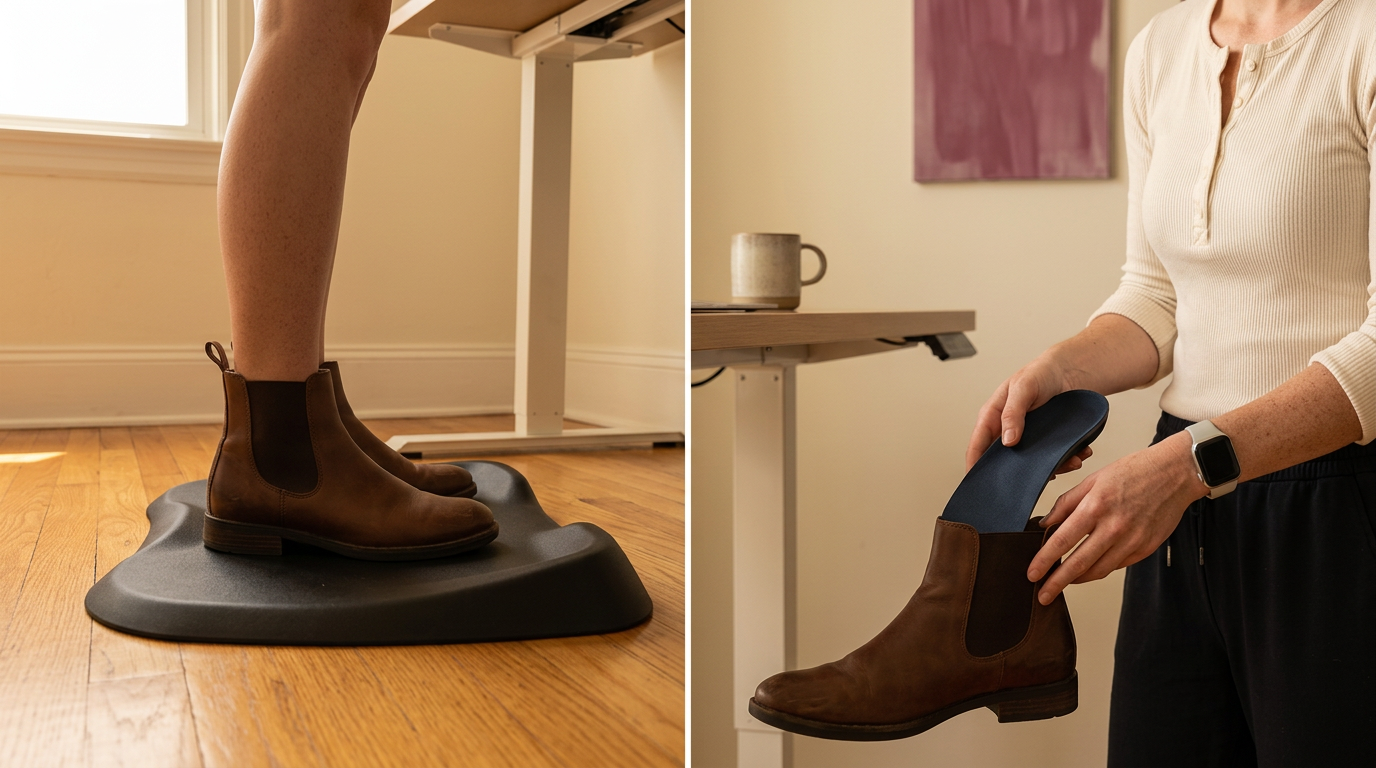
A mat and an insole look like they do the same thing. They do not. One works on the floor. The other works on the foot. Buying the wrong one — or only one — is why most people still hurt after spending money on standing desk comfort.
What each one actually does#
The insole#
Works inside the shoe. Its job is to support the arch, center the heel, and cushion the forefoot under static load. Without it, your foot flattens against the flat sole of whatever shoe you are wearing, and pressure concentrates on the heel and ball. That is the pain you feel after hour two.
The insole fixes: arch fatigue, heel loading, plantar fascia strain, and the lower-back tension that follows when feet lose alignment.
The mat#
Works under the shoe. Its job is to absorb impact from the floor surface, reduce the hardness transmitted through the sole, and encourage micro-movements that prevent static-load buildup. Contoured mats with ridges and slopes do this better than flat mats because they give your feet something to shift against.
The mat fixes: surface hardness fatigue, lower-leg stiffness, the “standing in one spot on concrete” problem, and the circulatory slowdown that happens when your feet stay locked in one position.
When you need one, the other, or both#
Insole only: you stand on carpet or a padded surface and your main complaint is arch or heel pain. The floor is already soft enough; the shoe is the problem.
Mat only: you already wear shoes with strong built-in arch support (structured trainers, purpose-built standing shoes) but stand on hardwood or concrete. The shoe is fine; the floor is the problem.
Both: you stand on a hard surface in boots, casual shoes, or flats — or you stand for more than two hours daily in any footwear. This is most people.
Neither: you stand under an hour a day and nothing hurts. Do not solve a problem you do not have.
The picks#
As an Amazon Associate I earn from qualifying purchases.
Insole: Fit Geno Heavy Duty Arch Support Insoles#
Fit Geno Heavy Duty Arch Support Insoles Amazon ↗(read review) — support-forward but softer-feeling than some harsher orthotic-style inserts. Strong arch help, good pain-relief signal, and easier day-to-day wearability than the most aggressive insole lane.
Mat: Ergodriven Topo#
Ergodriven Topo Standing Desk Mat Amazon ↗(read review) — contoured anti-fatigue mat with calculated terrain that encourages constant micro-movements. The raised edges and center mound give your feet something to push against, which prevents the static-standing problem flat mats only partially solve.
If your desk area is compact, the Ergodriven Topo Mini Standing Desk Mat Amazon ↗(read review) has the same calculated terrain in a smaller footprint.
Together#
The combination addresses both halves: the insole supports the foot inside the shoe, the mat cushions and activates the foot under the shoe. Neither fix is expensive, and together they extend comfortable standing from about two hours (unmodified) to four or more.
The 20-8-2 check#
Even with both, movement wins. Stand 20 minutes, sit 8, move 2. The mat and insole reduce fatigue; the rotation prevents it. No product stack replaces the cycle.