Mira’s Take#
If the Beryl AX is the travel router for people who live on wireless, the GL.iNet Slate AX (GL-AXT1800) is the one for people who still plug things in. It trades the Beryl’s faster radio for a more complete set of ports, on-router storage, and — the part VPN users care about most — a materially higher WireGuard ceiling.
This is the router I’d pick when the job is not just “get my laptop online safely” but “set up a small trusted network for a few days that can also route everything through a VPN without choking.” The quad-core Qualcomm silicon inside is the reason it can do that.
Why This Router Exists#
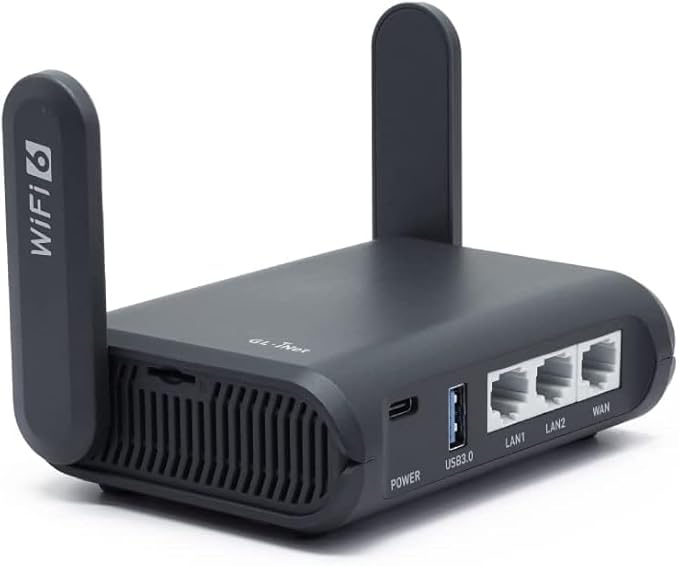
The Slate AX is GL.iNet’s answer to the traveler who wants a little desktop-router flexibility in a carry-on package. Where the Beryl AX has one LAN port, the Slate has two LAN ports plus a WAN port — three Gigabit jacks total. Where the Beryl has no card slot, the Slate has a microSD slot up to 512GB. And where the Beryl’s WireGuard tops out around 300 Mbps, the Slate is published at up to 550 Mbps.
It is not the faster router on paper for Wi-Fi — it is AX1800, not AX3000 — but for a lot of real travel scenarios, the wired flexibility and VPN headroom matter more than peak wireless throughput.
Specs at a Glance#
- Wi-Fi: Wi-Fi 6 (802.11ax), dual-band, AX1800 (600 + 1200 Mbps)
- Ports: 3× Gigabit Ethernet (1 WAN + 2 LAN) · 1× USB 3.0 · microSD up to 512GB
- SoC: Qualcomm IPQ6000, quad-core 1.2GHz · 512MB RAM · 128MB flash
- VPN: WireGuard up to 550 Mbps · OpenVPN + WireGuard client and server
- Firmware: OpenWrt-based, GL.iNet GL GUI 4.x
- Features: Repeater, USB tethering, WISP, AdGuard Home, Tor
- Size: 125 × 82 × 36 mm · 245 g · USB-C powered
- Price: ~$99
What It Actually Does Well#
- Wired flexibility. Two LAN ports plus WAN means you can hardwire a work laptop and a streaming box while still bridging to venue Wi-Fi — no dongles required.
- A real VPN ceiling. The 550 Mbps WireGuard figure is the headline. If you route all your traffic through a VPN as a matter of course, the Slate keeps up better than most travel hardware.
- On-router storage. The microSD slot plus USB 3.0 turns the Slate into a tiny travel NAS for sharing files across your devices over SMB.
- The same OpenWrt toolkit. AdGuard Home, Tor, tethering, repeater mode, and the GL GUI are all here — you are not giving up software to gain ports.
Not Ideal For#
- Chasing peak Wi-Fi speed. If your priority is the fastest wireless link and a 2.5Gbps WAN, the Beryl AX is the better radio.
- Absolute minimalists. At 245g the Slate is a touch larger and heavier than the Beryl. It is still pocketable, but the Beryl wins on sheer portability.
- People who never touch a VPN or an Ethernet cable. Much of what justifies the Slate over cheaper routers is wired and VPN headroom — if you use neither, you are paying for capability you will not touch.
Real-World Notes#
Same honesty caveat as its sibling: the Slate AX has been on the market since 2022 and is broadly well-reviewed by reputable networking outlets, but I don’t publish Amazon star counts I can’t verify against the live listing. The specs above are corroborated across GL.iNet’s documentation and multiple independent reviews.
The practical distinction I keep coming back to is this: the Slate’s advantage is not the Wi-Fi number, it is everything around the Wi-Fi — ports, storage, and VPN throughput. If those are the things your travel setup actually leans on, the AX1800 radio is a non-issue.
Mira’s Verdict#
The GL.iNet Slate AX is the travel router for people whose “travel network” is a real network — a couple of wired devices, a VPN tunnel carrying everything, maybe a shared drive. It is a little bigger and its Wi-Fi is a step slower than the Beryl’s, but the extra ports, the microSD slot, and the 550 Mbps WireGuard ceiling earn their keep.
If you would rather have the faster radio and a multi-gig WAN in a smaller shell, read the GL.iNet Beryl AX review and pick your trade-off.
GL.iNet Slate AX (GL-AXT1800) Amazon ↗// Frequently Asked Questions
Should I buy the GL.iNet Slate AX or the Beryl AX?
Choose the Slate AX (GL-AXT1800) if you want more wired ports, on-router microSD storage, and the higher published WireGuard ceiling of 550 Mbps. Choose the Beryl AX (GL-MT3000) if you want the faster AX3000 radio and a 2.5Gbps WAN port in a slightly smaller body. The Slate is the wired-and-VPN pick; the Beryl is the raw-wireless-speed pick.
How fast is WireGuard on the GL.iNet Slate AX?
GL.iNet publishes WireGuard performance of up to 550 Mbps on the Slate AX, driven by its quad-core Qualcomm IPQ6000 processor. That is meaningfully higher than the Beryl AX's 300 Mbps ceiling and is the main reason VPN-heavy users pick the Slate.
Does the GL.iNet Slate AX have a microSD card slot?
Yes. The Slate AX includes a microSD (TF) slot supporting cards up to 512GB, plus a USB 3.0 port, so you can attach network storage and share files across your travel network — something the Beryl AX cannot do without USB.
Is the GL.iNet Slate AX a Wi-Fi 6 router?
Yes. The Slate AX is a dual-band Wi-Fi 6 (802.11ax) router in the AX1800 class — 600 Mbps on 2.4GHz and 1200 Mbps on 5GHz. Its Wi-Fi is a step below the Beryl AX's AX3000 radio, but it makes up ground with three Gigabit ports and a higher VPN ceiling.
Referenced In Comparisons
- Best Travel Routers for Remote Work
A practical shortlist of travel routers for hotel Wi-Fi, Airbnb setups, and remote-work trips where security and consistency matter more than raw speed.