Mira’s Take#
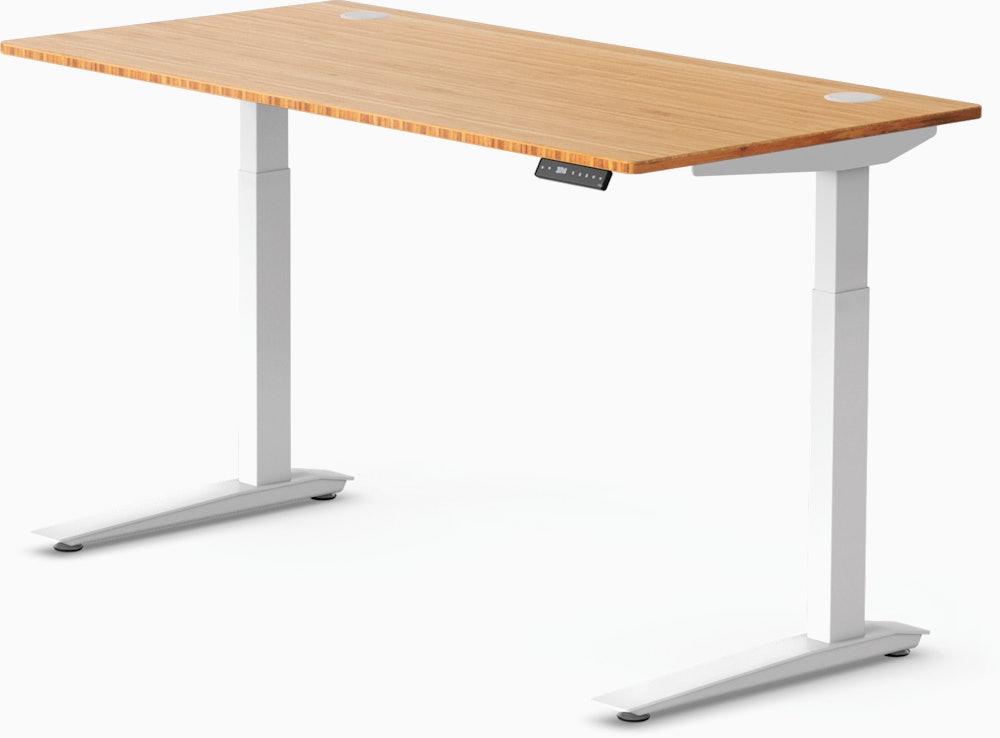
If you are reading this Jarvis standing desk review, the real question is not whether the desk looks good in staged photos. It is whether the Jarvis still deserves premium money now that it sits inside the Herman Miller/MillerKnoll ecosystem and competes against easier-to-buy alternatives from UPLIFT, FlexiSpot, and Branch.
As of May 2026, Herman Miller lists the Jarvis Bamboo Standing Desk starting around $1,075 for the rectangular bamboo version before configuration changes. That keeps the Jarvis in premium-desk territory, not “cheap standing desk” territory.
The recent buyer pattern is strong. Across Herman Miller and DWR reviews, people keep returning to the same three points: the desk feels sturdy, the height adjustment works for more body types than many competitors, and the bamboo top looks warmer and more furniture-like than cheaper laminate desks. If you’re weighing the fit, check the ideal standing desk height for your body to confirm the Jarvis’s range works for you.
That does not mean it is frictionless. Assembly still comes up often enough to take seriously, and support risk is part of the conversation now that the brand sits under Herman Miller. But the core product signal is still better than the cautionary signal: most buyers sound happy once the desk is built and in use.
Quick Verdict#
Buy the Jarvis if you want a warmer bamboo desktop, a stable two-leg frame, and a desk that feels more like furniture than commodity office equipment. Skip it if your decision depends on Amazon ordering, the lowest price, or a support path that feels simple if something arrives wrong.
| Buyer priority | Best fit |
|---|---|
| Premium bamboo look | Jarvis Bamboo Standing Desk |
| Amazon ordering and premium stability | UPLIFTDESK V3 Amazon ↗(read review) |
| Bamboo top with simpler buying path | FlexiSpot E6 Bamboo Amazon ↗(read review) |
| Cheapest useful electric desk | Veken 55 Inch Standing Desk Amazon ↗(read review) |
If you are only asking “is the Jarvis good?” the answer is yes. If you are asking “is it the best standing desk for my money?” the answer depends on whether the bamboo finish and premium stability are worth giving up a more convenient buying path.
Why It Stands Out#
There are several useful signals in the review set:
- Repeated claims that the desk stays stable at full standing height, including from buyers who explicitly compared it against wobblier desks.
- Strong feedback on the bamboo top, which buyers describe as warmer, cleaner, and more attractive than cheaper laminate alternatives.
- Credible height-range praise from both shorter users and taller users, which matters because too many standing desks are only truly comfortable for the middle of the bell curve.
- Consistent mentions of quiet motor behavior and memory presets, which are the exact features that make switching positions easy enough to become a habit.
- An independent long-form owner review also lands on the same basic strengths: strong stability, solid fit and finish, and assembly that was manageable solo but easier with help when flipping the desk.
That combination matters more than a giant feature matrix. Standing desks live or die on stability, motion quality, and whether the owner actually wants to use the standing function every day.
What the Real Tradeoff Is#
The tradeoff is not desk quality. It is setup effort, price, and buying path.
Several buyers describe assembly as simple enough if you follow the instructions or videos carefully, but others call it annoying or harder than expected. That is a very normal premium-desk pattern: the finished result is polished, but the trip from box to usable workstation is not always elegant.
The other tradeoff is obvious. This is not the bargain-bin answer to “I want a desk that goes up and down.” It is the more expensive answer for people who care about stability, materials, and long-term daily use more than shaving every dollar off the order total.
The third tradeoff is availability. The Jarvis is a direct Herman Miller purchase, not an Amazon-native product. That matters if you value Prime shipping, familiar returns, or a purchase path with lots of visible marketplace feedback.
What Buyers Seem to Like#
Stability is the headline. Multiple recent reviewers describe the desk as rock-solid, explicitly saying there is little or no wobble even at full standing height. That matters because once a desk starts shaking under normal typing, everything else about it becomes secondary.
The bamboo top is the second clear win. Buyers keep calling out the look and feel of the surface, describing it as stylish, warm, clean, and a real upgrade over more generic finishes. That is useful because a standing desk is not just an ergonomic tool. It is also a large visual object that dominates the room.
Adjustability is the third major positive. One buyer specifically praised it for going low enough for people shorter than 5'8", while laminate-line reviews also confirm that the extended-height options work well for taller users. That suggests the Jarvis is not only flexible in theory, but flexible in ways actual buyers notice.
There is also steady praise for the motor and presets. Buyers describe the lift as quiet, quick, and easy to use, with saved positions making sit-stand changes much less annoying.
What Buyers Flagged#
Assembly is the main caution flag. The feedback is not catastrophic, but it is consistent enough to plan around. If you hate furniture assembly or expect a premium desk to arrive as a nearly effortless setup, the Jarvis may test your patience for an afternoon. One independent owner writeup described the process as pretty easy overall, but still a one-to-two-hour job and easier with a second person for the flip.
Shipping in multiple boxes also shows up in the broader Jarvis review pattern. That is not automatically a problem, but it raises the odds of a more fragmented delivery and a less tidy unboxing process.
There is also a real service-risk caveat. A Reddit thread in the Herman Miller community describes repeated warranty and replacement-part frustration and includes commenters split between “mine has been flawless for years” and “support was a pain when something went wrong.” I would not treat one thread as definitive product proof, but I would treat it as enough signal to take post-purchase support risk seriously.
What is notable is that the product-quality signal itself still looks better than the support-risk signal. Most of the strong recent retail reviews are praising stability, finish, and motion quality, while the harsher anecdotal criticism leans more toward service, warranty timing, and replacement-part hassle than toward a universally bad desk.
Is the Jarvis Desk Worth It?#
For most buyers who land on this question: yes, but with a specific caveat about what you are optimizing for.
The Jarvis is worth it if you care about long-term stability and desktop material more than you care about saving $200-$300 on the frame. Buyers who treat this as a one-time workstation investment and assemble it carefully tend to stop thinking about the desk entirely, which is what a good desk should do.
It is not worth it if your main goal is the cheapest path to a height-adjustable desk. Better budget alternatives exist, and the Jarvis does not try to compete with them on price. The question is not whether it is a good desk. It is whether it is the right desk for your situation and what you are willing to spend.
For 2026 buyers, the best Jarvis argument is not “best value.” It is “premium bamboo desk with unusually strong long-term stability feedback.” That is a narrower but cleaner pitch.
Current Jarvis Pricing and Lineup#
The current Herman Miller listing centers the Jarvis Bamboo Standing Desk as a configurable premium desk with rectangular and contour desktop shapes. The rectangular bamboo version is the cleaner default for most home offices because it keeps the price lower and works with more monitor-arm and cable-management layouts.
The contour version costs more and makes sense if you specifically want the curved front edge for closer keyboard and mouse positioning. It is less compelling if you mostly need a flat, flexible work surface for monitors, speakers, notebooks, and a laptop dock.
Herman Miller’s current product page still positions the Jarvis around the core specs that made it popular: FSC-certified bamboo, 350-pound lifting capacity, memory presets, quiet lift behavior, and a warranty split across top, frame, motors, and electrical components. Those are good specs. The reason to keep comparing is not that the Jarvis is weak; it is that premium-desk buyers now have more easier-to-order alternatives than they did when Fully was still the obvious direct-to-consumer choice.
Are Jarvis Standing Desks Good?#
The current buyer signal says yes. Across retail reviews and independent owner writeups, the recurring strengths are stability at full standing height, a wide enough height range to work for shorter and taller users, and a desktop finish that actually improves the room. The motor and preset system also draw consistent praise — not because they are exotic features, but because they work quietly and consistently enough that switching positions becomes something you actually do.
The one area where the signal weakens is post-sale support. Product quality reviews and warranty experience reviews are telling different stories right now. That split is worth taking seriously if you tend to run into edge cases with hardware, but it does not change the product-quality conclusion for most buyers who get a clean unit.
Jarvis Bamboo vs Laminate#
The Jarvis ships in both bamboo and laminate versions. The choice matters more than most people realize before they order.
Bamboo is the warmest-looking option and consistently draws better finish feedback in the review set. Buyers describe it as furniture-grade rather than office-equipment-grade, which matters if the desk is the dominant visual object in the room. It is also more sustainable as a material. The tradeoff is that bamboo can show wear faster than a durable laminate finish, particularly if you drag heavy equipment across the surface.
Laminate is the more practical surface for heavy daily use. It is easier to clean, more resistant to surface damage, and available in more size and color configurations. If you run monitors on an arm with a heavy cable bundle and move gear around often, laminate is the less precious option.
Neither is a wrong choice. The bamboo version earns its premium look; the laminate version earns its durability. Choose based on whether you are optimizing for aesthetics or long-term surface resilience.
Jarvis Stability and Wobble#
Wobble is the most-cited failure mode for standing desks in this price range, and it is worth addressing directly.
The buyer pattern on the Jarvis is unusually consistent on this point: multiple reviewers who explicitly tested stability against other desks describe it as rock-solid at full standing height. That is a meaningful signal, because wobble testing is the first thing motivated buyers notice, and negative results show up loudly in reviews.
That said, no two-leg standing desk is perfectly rigid. Longer desktop configurations introduce more leverage on the frame, and setup quality affects final rigidity. If you are running a very wide desktop with a heavily loaded monitor arm at the far edge, that will expose more movement than a center-weighted single-monitor setup. The Jarvis handles typical real-world configurations well. It is not the answer to an unusually demanding load scenario.
What Changed with Fully and Herman Miller#
Fully, the original manufacturer of the Jarvis, was acquired by Herman Miller in 2022. Herman Miller was subsequently acquired by MillerKnoll.
The practical effect on the Jarvis has been mixed. On the product side, the desk itself has maintained its core reputation — the frame quality and desktop finish reviews have not deteriorated in a way that suggests the product changed materially post-acquisition. On the service side, the picture is less clean. Some owners report longer resolution times and more friction with warranty claims than the Fully-era experience, and there is credible community signal on Reddit that support responsiveness has been inconsistent.
This is not a reason to avoid the desk. It is a reason to document your purchase, hold onto receipts and order confirmations, and go in with realistic expectations about what premium support means under a large conglomerate compared to a smaller direct brand.
Can You Buy the Jarvis on Amazon?#
No. The Jarvis is not sold on Amazon.
That matters more than it sounds if you prefer Prime shipping, easier return handling, or a purchase that folds into your existing Amazon order history. It does not make the Jarvis a bad buy. It just means the buying path is less convenient than some of the desks people cross-shop against it. If you want a broader shortlist before deciding, the UPLIFTDESK V3 review covers the strongest Amazon-available premium alternative in this category.
If Amazon Availability Matters, Start Here Instead#
If the Jarvis fits what you want but Amazon availability is part of the decision, these are the better next stops.
For a cheaper first standing desk#
Veken 55 Inch Large Electric Standing Desk Amazon ↗ makes more sense if your goal is straightforward: get memory presets, electric lift, and enough space for a normal work setup without paying Jarvis money. You give up some finish quality and long-term polish, but it is the better fit for budget-first buyers.
For a bamboo desk with Amazon ordering#
FlexiSpot E6 Bamboo Standing Desk Amazon ↗ is the bridge option if what you really want is the Jarvis idea with a simpler buying path. The appeal is obvious: one-piece bamboo top, dual motors, and Amazon availability. The tradeoff is that the assembly and hole-alignment signal is noisier than what you want from a true premium desk. For the full read, use the FlexiSpot E6 Bamboo review .
For a premium desk with a cleaner buying path#
UPLIFTDESK V3 2-Leg Standing Desk Amazon ↗ is the main premium alternative worth cross-shopping. It competes on stability, works well for heavier setups, and has a stronger accessory ecosystem. If you like the idea of the Jarvis but want a more straightforward buying path, this is the first place to look.
If you are not sure a desk is the right first upgrade#
Read Standing Desk vs Chair: Which Should You Buy First? before you commit. In some setups, the bigger improvement comes from fixing the chair, monitor height, or overall ergonomics first.
Best For#
- Remote workers and coders who want a standing desk that still feels planted when typing aggressively.
- Buyers who care about the desktop material and want a warmer, less sterile look than standard laminate.
- Shorter or taller users who have been burned by desks with a narrower practical height range.
- People willing to tolerate a more involved setup in exchange for a desk that feels like a long-term workstation foundation.
Not Ideal For#
- Shoppers who only want the cheapest functional motorized desk.
- Anyone who wants a zero-hassle, one-box, trivially simple assembly experience.
- Buyers who do not care about the difference between a nicer desktop finish and a more basic top.
Mira’s Verdict#
The Jarvis still looks like the right kind of premium standing desk: not flashy for the sake of it, just materially better where it counts. The core product signal is coherent. People keep describing the same strengths: strong stability, useful range, quiet movement, and a desktop that actually improves the feel of the room.
If your main fear is wobble, the review pattern is reassuring. If your main fear is assembly annoyance, that concern is real, but it still looks like a temporary cost rather than the main long-term problem. The bigger open question is support: if you get a good unit, buyers often love it; if you need warranty help, at least some owners report a much rougher experience than a premium desk should involve. That pushes the Jarvis slightly out of “easy universal recommendation” territory and into “strong desk, but buy with eyes open.”
If you buy one, finish the setup with the Cable Sleeve Kit review and the UPLIFTDESK V3 standing desk review. If you want a broader comparison before deciding, start with the UPLIFTDESK V3 review — the two desks are worth comparing directly before committing.
// Frequently Asked Questions
Can you buy the Jarvis on Amazon?
No. The Jarvis is not sold on Amazon, so buyers who want Amazon ordering, easier returns, or a simpler buying path should compare alternatives like UPLIFTDESK V3 or Veken instead.
Is the Fully Jarvis standing desk worth it?
For buyers who prioritize long-term stability and desktop material quality over price, yes. The Fully Jarvis earns consistent praise for stability at full standing height, a wide height range that works for both shorter and taller users, and a bamboo top that feels furniture-grade rather than office-equipment-grade. The main caveat is post-sale support: service experience has been inconsistent since Fully was acquired by Herman Miller.
How does the Fully Jarvis compare to UPLIFT?
Both are premium two-leg standing desks competing on stability and build quality. The key difference is buying path: the UPLIFTDESK V3 is available on Amazon with easier returns, while the Fully Jarvis ships direct. UPLIFT also has a stronger accessory ecosystem. If Amazon availability matters, UPLIFT is the stronger choice; if the bamboo desktop is the priority, the Fully Jarvis is worth the more involved purchase.
How does the Jarvis compare to FlexiSpot?
The FlexiSpot E6 Bamboo is often cross-shopped by buyers who want a bamboo desktop with Amazon ordering. The E6 costs less and ships more conveniently, but buyer feedback on assembly hole alignment is noisier than what you expect from a true premium desk. The Jarvis typically draws cleaner stability feedback at full standing height.
What is the weight capacity of the Fully Jarvis standing desk?
The Fully Jarvis has a 350-pound weight capacity, which covers most standing desk setups including dual monitors, a laptop, and standard accessories.
Related Reviews
- UPLIFTDESK V3 2-Leg Walnut Laminate Wood Standing Desk
A premium standing desk with quieter dual motors, strong stability, and better cable management for people who want a more polished long-term setup.
- Cable Sleeve Kit
A practical starter kit for taming visible cable clutter when you want cleaner runs without drilling into anything.
Referenced In Reviews
- FlexiSpot E6 Bamboo Standing Desk
A bamboo-top standing desk with dual motors, memory presets, and a stronger Amazon buying path for people who like the Jarvis idea but want a simpler order flow.