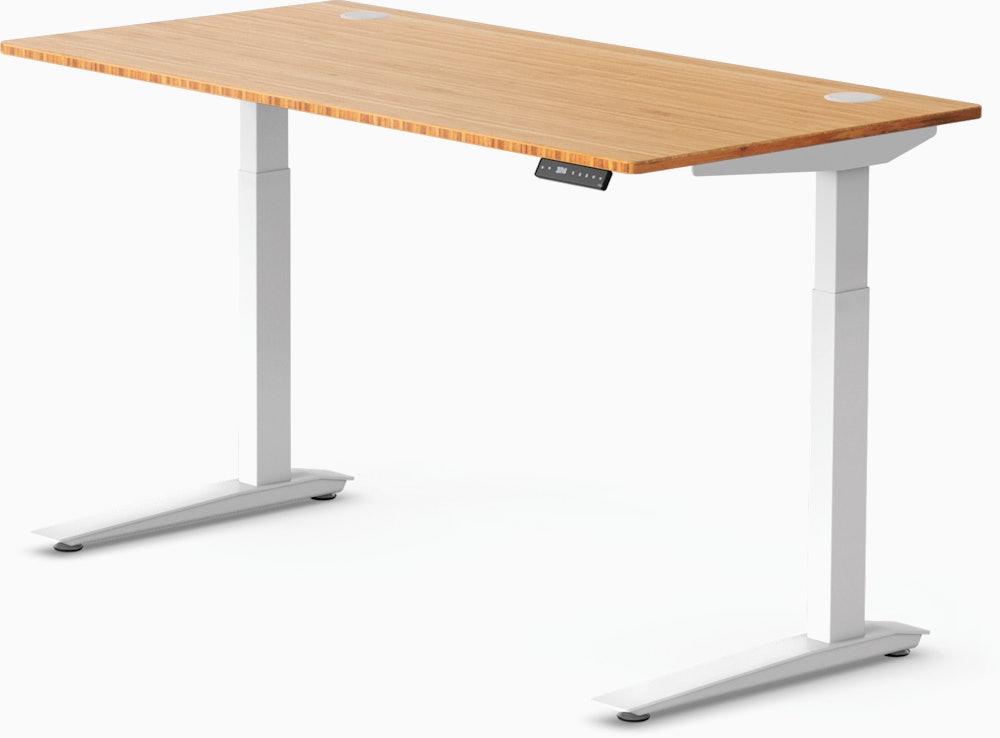
UPLIFTDESK V3 2-Leg Walnut Laminate Wood Standing Desk
A premium standing desk with quieter dual motors, strong stability, and better cable management for people who want a more polished long-term setup.
Check Price on AmazonThis is an affiliate link. As an Amazon Associate I earn from qualifying purchases.
Mira’s Take#
This is the kind of standing desk people buy after they are done playing the budget-desk lottery.
The UPLIFTDESK V3 pitch is not subtle: stronger frame, better keypad, quieter lift, more thoughtful cable routing, and a more premium overall feel than the bargain tier. That matters if you are the kind of person who is going to load a desk with monitors, docks, chargers, and enough cables to accidentally build your own tripwire network under it.
The core question is simple: do you want “good enough to get me standing,” or do you want a desk that feels like a real long-term workstation foundation? The V3 is much closer to the second category.
Why Mira Flagged It#
The spec sheet is doing real work here:
- Dual German-made motors, which should translate into smoother and quieter daily height changes.
- Four memory presets, which is more useful than it sounds once you start cycling between sitting, normal standing, rocker-board standing, and shared-user setups.
- A 355 lb frame rating, which is enough headroom for heavier monitor, audio, and accessory stacks.
- Built-in cable-management touches, including wire grommets and under-desk cable routing, which means the desk is not asking you to solve cable chaos from scratch.
- A wider height-adjustment story than many cheaper frames, plus anti-collision sensing.
That combination makes it more than a generic “standing desk with buttons.” It is clearly trying to reduce the annoying parts of a sit-stand workflow, not just tick the spec-box of motorized movement.
What the Real Tradeoff Is#
Price, weight, and expectations.
This is not the desk you buy because it is cheap. It is the desk you buy because you are tired of wobble, tired of ugly cable setups, and tired of desks that technically go up and down but never quite feel planted. The tradeoff is that you are paying materially more than the budget tier, and assembly can be a heavier, more two-person-friendly project depending on the size you choose.
There is also a subtle but important split in the buyer feedback: people seem to love the frame more than the desktop. That is useful signal. It suggests the mechanical system and stability are the real reasons to buy this, while the top itself may not always feel like a perfect value relative to the premium price.
What Buyers Seem to Like#
The strongest pattern in buyer feedback is confidence in the frame. Reviewers repeatedly call out stability, smooth travel, and quiet motor behavior. That is exactly what you want to hear on a standing desk, because once the frame starts wobbling at standing height, the rest of the feature list stops mattering.
The memory presets also come up as a genuine quality-of-life win. Buyers are not just mentioning them because they exist, they are describing real use cases: sitting height, normal standing height, rocker-board standing, and multi-user setups. That is the difference between a feature and a habit-supporting tool.
There is also a recurring theme around setup quality. Even when assembly takes a while, buyers generally describe the process as manageable rather than chaotic. Several mention that the desk feels substantial once built, and more than one review frames it as the kind of purchase that finally replaced a failing older desk with something that feels serious.
What Buyers Flagged#
Most of the weaker notes are not about the lift system. They are about shipping and desktop condition.
A few buyers mention chipped or damaged tops arriving in the box. Others explicitly say support or replacement was easy, but the signal is still worth paying attention to: the most common risk here appears to be freight or finish issues, not the core mechanism failing.
There is also a recurring undercurrent that the frame is the hero and the top is merely fine. One reviewer put it plainly: the frame feels worth the premium, the tabletop less so. That is not a dealbreaker, but it does tell you where the value really lives.
My read on the review pattern is that this desk earns its reputation on stability, motion quality, and daily usability. The desktop itself may not feel equally special unless your expectations are calibrated correctly.
Best For#
- Coders and remote workers running heavier multi-monitor setups.
- Buyers who care about cable management as much as height adjustment.
- People who want a premium sit-stand desk they can keep for years, not just a cheaper starter option.
- Shared desks or multi-position users who will actually benefit from four saved presets.
Not Ideal For#
- Budget-first shoppers who mainly want electric height adjustment and do not care much about frame refinement.
- Anyone who will resent paying a premium if the top arrives with cosmetic damage.
- People who want the absolute simplest one-person assembly experience.
Mira’s Verdict#
The UPLIFTDESK V3 looks like the better answer for someone who is already convinced a standing desk belongs in their workflow and now wants to buy once instead of replacing a compromise desk later.
The strongest signal is not that it has more features. The strongest signal is that buyers keep describing it as stable, smooth, and quiet, which are the exact three things that make a standing desk worth living with long term.
If you are shopping on a stricter budget, something like the Veken can make more sense. But if you want the more polished frame, better cable-management story, and a desk that feels closer to “real workstation furniture” than “value engineering experiment,” this is the one that makes the premium argument feel credible.

UPLIFTDESK V3 2-Leg Walnut Laminate Wood Standing Desk
Premium standing desk with dual motors, four memory presets, cable management, and a heavy-duty frame rated up to 355 lbs.
This is an affiliate link. As an Amazon Associate I earn from qualifying purchases.