Best Travel Routers for Remote Work

If you work from hotels long enough, you stop trusting the Wi-Fi. A travel router gives you a private network you control, even when the building's network is mediocre: one stable SSID, a VPN at the router instead of on every device, and no reconnecting everything at each new property. Two GL.iNet routers cover nearly every remote-work trip; the split is how much headroom you need.
As an Amazon Associate I earn from qualifying purchases. Prices aren't shown — tap through to check the current price on Amazon.
At a glance
How this page was put together: the router specs come from GL.iNet’s Beryl AX product page and datasheet, and its Slate AX product page and datasheet. We haven’t carried these routers ourselves; the setup advice follows from what each feature does.
This page is the comparison version of the narrower Ask Mira answer: What Travel Router Should I Carry for Remote Work in Hotels?. The question page helps you decide if you need one. This guide is where the actual buying call gets made.
What Actually Matters in a Travel Router#
- WISP or repeater mode that behaves cleanly with hotel captive portals
- Easy WireGuard or VPN client setup before you leave home
- USB-C or simple power options that fit the rest of your bag
- Stable enough performance that all your devices can stay on one SSID all trip
Who Should Actually Buy One#
You probably need a travel router if:
- you work from hotels more than a few times a year
- you bring a laptop, phone, tablet, and maybe a streaming stick or portable monitor
- you do client calls on building Wi-Fi you do not control
- you want your devices behind your own network instead of reconnecting each one to hotel login pages
You probably do not need one if:
- you rarely work away from home
- you only travel with one laptop and hotspot from your phone
- you are trying to keep the bag absolutely minimal
Beryl AX vs Slate AX#
GL.iNet lists the GL.iNet Beryl AX (GL-MT3000) Amazon ↗(read review) at 574 Mbps on 2.4GHz and 2402 Mbps on 5GHz, with a 2.5G WAN port, a 1G LAN port, USB 3.0, 512MB RAM and 256MB flash. It lists the GL.iNet Slate AX (GL-AXT1800) Amazon ↗(read review) at 600 Mbps on 2.4GHz and 1200 Mbps on 5GHz, with OpenVPN up to 500 Mbps (DCO), WireGuard up to 550 Mbps, OpenWrt 21.02 support, DFS and file sharing.
The practical split:
- Buy the Beryl AX if you want the smallest reliable answer for hotel rooms, Airbnbs, coworking days, and one-person remote work.
- Buy the Slate AX if you travel with more devices, run heavier VPN sessions, share the connection, or want the router to feel less like a minimal travel accessory and more like a portable network hub.
For most people, Beryl AX first. Slate AX only if you already know why the extra headroom matters.
Hotel Wi-Fi vs Airbnb Wi-Fi#
Hotels and Airbnbs fail differently.
Hotel Wi-Fi is usually the captive-portal problem. You connect, accept terms, maybe enter a room number, and hope every device behaves. A travel router helps because it can authenticate once, then let your devices connect to your private SSID. That means your laptop, phone, tablet, streaming stick, and portable monitor adapter stay on the same network across the trip instead of each fighting the property login page.
Airbnb Wi-Fi is usually the trust and consistency problem. You may get a normal router with a normal password, but you do not control the firmware, guest network, owner access, or how many previous guests have used the same credentials. A travel router gives your devices their own layer and lets you run a VPN profile at the router level instead of remembering to start VPN apps one by one.
The move is the same in both places: connect the travel router to whatever internet the property gives you, then keep your devices on your own SSID. You are not making bad upstream bandwidth good. You are making an unfamiliar network less annoying and less exposed.
Pre-Trip Setup Guide#
Do the setup at home. Not in the hotel room. Not in the airport lounge. Not ten minutes before a client call.
- Update the router firmware.
- Change the admin password.
- Create a private SSID and password you will reuse on trips.
- Add your WireGuard or OpenVPN profile.
- Test VPN autoconnect.
- Test Ethernet-in if you have an adapter or room jack available.
- Test WISP/repeater mode against your home Wi-Fi so the captive-portal workflow feels familiar.
- Label the router, cable, and charger so they do not disappear into the bag.
The reason this matters is boring: travel is already a stack of small failures. If the router is configured before you leave, hotel setup becomes a two-minute ritual instead of a troubleshooting session.
Travel Connectivity Pouch#
The router is only one piece of the kit. The full pouch should solve power, Ethernet, fallback internet, and cable weirdness without making the bag feel like a drawer.
Pack this:
- Travel router: Beryl AX for most trips, Slate AX for heavier setups.
- Short USB-C power cable: short enough that it does not tangle with the desk.
- 20W or stronger USB-C wall charger: enough to power the router without stealing your laptop brick.
- Flat Ethernet cable: useful in hotels, conference rooms, and older Airbnbs with a working wall jack.
- USB-C Ethernet adapter: for laptops that need a wired fallback.
- Tiny label or card with the router admin URL and private SSID: not the password, just the setup reminder.
- Backup SIM/hotspot plan if the trip is work-critical.
Keep the pouch boring and repeatable. The win is not raw speed. The win is walking into a hotel or Airbnb and making the network feel like yours.
GL.iNet Beryl AX (GL-MT3000)

The cleaner first buy. It's small enough to live in a tech pouch and still has the features that matter on the road: Wi-Fi 6, OpenWrt-based firmware, VPN client support, repeater/WISP mode, USB-C power and Ethernet fallback. GL.iNet lists it as an AX3000 router with a 2.5G WAN port, a 1G LAN port and USB 3.0. For hotel rooms, Airbnbs and one-person remote work, this is where I'd start.
- AX3000 Wi-Fi 6 with a 2.5G WAN port, per GL.iNet's datasheet
- USB-C power fits the charger already in the bag
- Repeater/WISP mode and VPN client support for hotel captive portals
- Less headroom for heavy multi-device or shared setups
- Only one LAN port
GL.iNet Slate AX (GL-AXT1800)
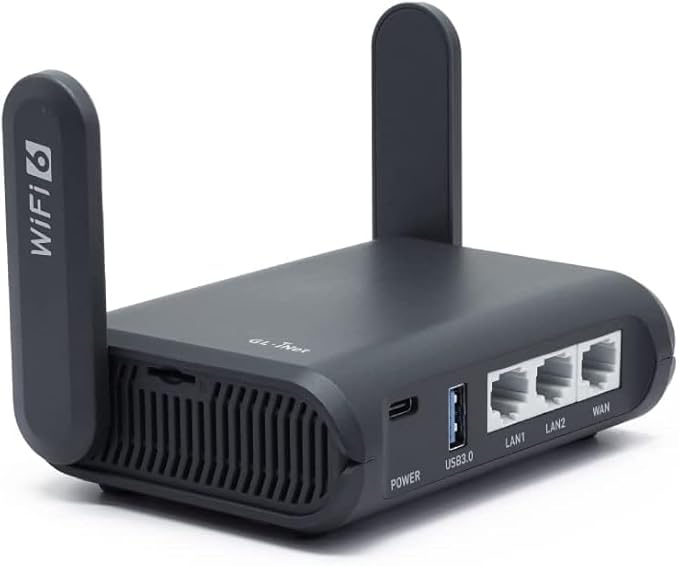
The more capable bag router. GL.iNet lists it as an AX1800 router with WireGuard up to 550 Mbps and OpenVPN up to 500 Mbps with DCO support, plus DFS and file sharing. Not everyone needs that. It earns its place when the trip turns into a real work setup: more devices, heavier VPN sessions, or a connection shared with someone else.
- WireGuard up to 550 Mbps and OpenVPN up to 500 Mbps, per GL.iNet
- More headroom when the router is a portable network hub
- OpenWrt 21.02 support for people who want to tinker
- Bigger footprint than the Beryl AX
- More router than a casual traveler needs
// Frequently Asked Questions
Do remote workers really need a travel router?
Not always, but they help a lot when you work from hotels, share sketchy Wi-Fi, or carry multiple devices that you want on one stable private network.
What matters most in a travel router for hotels?
Reliable repeater mode, easy VPN support, sane setup, and enough portability that you will actually carry it.
Should I buy the smaller or more powerful model?
The smaller model usually wins for simple hotel and Airbnb work. The more powerful model only makes sense if you expect heavier multi-device loads or want more headroom.
Can a travel router bypass a hotel captive portal?
Usually yes, but not magically. You still authenticate once through the hotel portal, then the travel router shares that connection to your private SSID so your laptop, phone, tablet, and streaming stick do not each need their own login.
Should I set up the travel router before leaving home?
Yes. Update firmware, change the admin password, create your private SSID, and import your VPN profile before the trip. The hotel room is the worst place to learn router setup.
Related Ask Mira
- What Travel Router Should I Carry for Remote Work in Hotels?
Hotel Wi‑Fi is slow and sketchy. Mira picks a travel router loadout that keeps you connected and safe.